Chemistry Department
The WSU Chemistry Department is committed to working with students in an inclusive and friendly environment and helping them achieve their personal and professional goals.
Our program is accredited by the American Chemical Society. The department offers a variety of majors and minors in chemistry, biochemistry, chemistry teaching, physical science teaching, and environmental science.
Our faculty members are active research scientists and are committed to provide a quality undergraduate education in chemistry. All sub-disciplines of chemistry—inorganic, organic, physical, analytical, biological and polymer—are well represented by our diverse faculty.
Our department aims to provide superb undergraduate educational experiences to our students.
Small class sizes and ample experiential learning opportunities lead to a high level of interaction between the faculty and students.
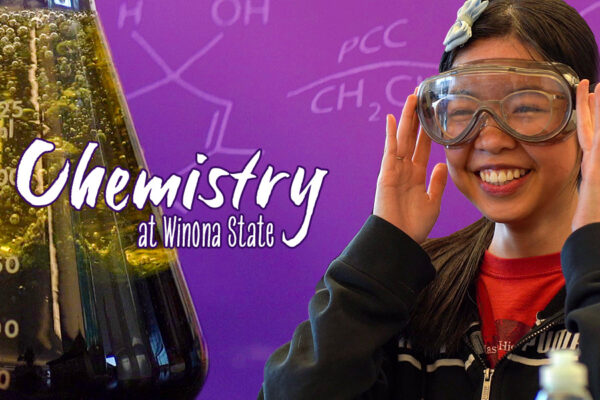
Internships and research experiences for undergraduates (REUs) are available on campus alongside our chemistry faculty. Students can also find opportunities to intern and research at other institutions across the country all year-round.
For the past three years, over 90% of graduates in chemistry or biochemistry have been placed in careers or graduate schools shortly after graduation.
We have excellent laboratory facilities in Pasteur Hall and the Science Laboratory Center dedicated to teaching and research.
Our state-of-the-art instrumentation includes excellent IR, NMR, UV-vis, AA, and fluorescence spectrometers. We also have capabilities for x-ray powder diffraction, scanning electron microscopy, x-ray microanalysis, multi-angle light scattering, liquid chromatography, and gas chromatography (with a wide variety of detectors).