Nursing (Direct Entry)
Master's
PROGRAM SNAPSHOT
Your previous degree doesn’t have to define your profession forever.
Bring what you already know into nursing, build new skills, and prepare for a career where your work can make a real difference every day.
This program is pending Minnesota Board of Nursing approval.
Why Study Nursing (Direct Entry) at Winona State?
Nurses are often the people who patients see, trust, and turn to most.
They care for people when they’re healthy and when they’re sick, during routine appointments and unexpected emergencies, and throughout some of life’s biggest moments.
They assess what’s happening, recognize when something changes, make decisions, explain complex information, advocate for patients and families, and work with doctors and other healthcare professionals to provide the best possible care.
But nursing is about much more than the hospital bedside.
Nurses work in schools, clinics, public health agencies, community organizations, long-term care facilities, homes, and countless other settings.
They help prevent illness, promote healthy communities, improve patient safety, use technology to make health care smarter, and find ways to make the healthcare system work better.
If your bachelor’s degree taught you how to communicate, solve problems, understand human behavior, analyze information, lead others, or think creatively, those skills don’t disappear when you change careers.
Those skills become part of the nurse you become.
The proposed Nursing (Direct Entry) master’s degree program at Winona State is designed for anyone who already has a bachelor’s degree in another field and who wants to become a Registered Nurse (RN).
Instead of starting over and going back to school for another undergraduate degree, you’ll build on your previous education through graduate-level nursing coursework, hands-on skills training, and supervised clinical experiences.
In just 4 semesters of full-time study, you’ll earn a Master of Science while preparing to pursue RN licensure.
Based at the WSU-Rochester campus, this proposed program will give you access to a plethora of clinical settings, including academic medical, community hospital, ambulatory, long-term care, public health, and school health.
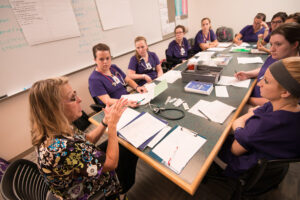
You’ll also learn in a small cohort, with one cohort admitted each summer. In other words, your faculty will know you by name and will be able to offer personalized support from day one through graduation.
Even better, the Department of Graduate Nursing secures and assigns every clinical experience, so you don’t have to find your own placements.
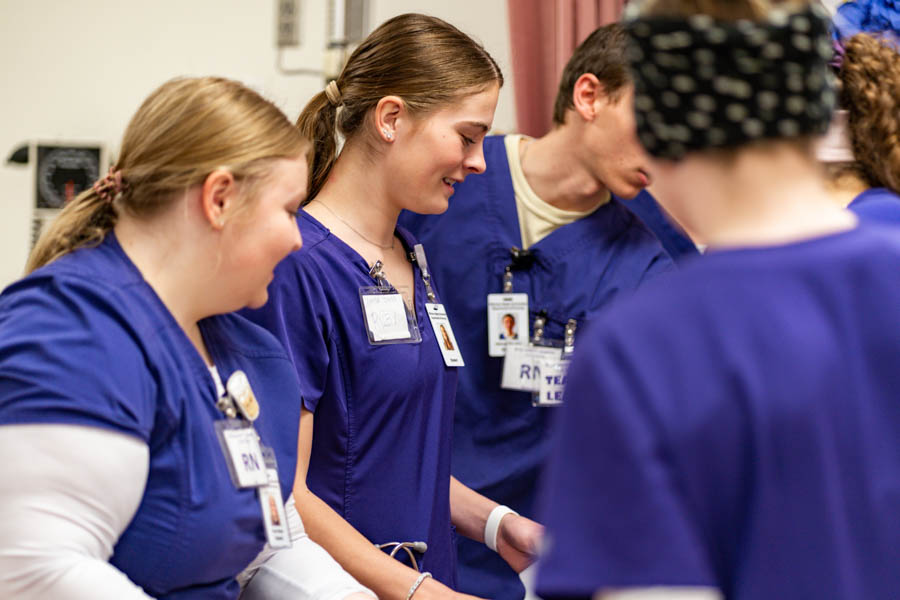
of Nursing (Direct Entry) clinical groups.
built in to help you get experience with patients across the lifespan and the wellness, acute illness, and chronic illness continuum.
Winona State has prepared nurses since 1964 and has offered graduate nursing education since 1987.
What Will You Learn as a Nursing (Direct Entry) Student?
Nursing requires more than knowing how to care for a patient.
You’ll learn how to think critically, recognize changes in a patient’s condition, make evidence-based decisions, communicate with patients and healthcare teams, and understand the larger systems that shape health care.
The proposed curriculum is organized around the 2026 essentials from the American Association of Colleges of Nursing and the Clinical Judgment Measurement Model from the National Council of State Boards of Nursing, which underlies the NCLEX RN licensing exam.
You’ll learn about:
Advanced pathophysiology
Pharmaco-therapeutics
Integrated health assessment
Hands-on nursing skills
Adult health
Mental health
Obstetric and newborn care
Nursing care for children
Community and public health, including opportunities to learn in community settings
Information management
Technology
Clinical decision making
Research methods and statistics for health care, plus applying current research to clinical questions
Health policy
Quality health care delivery
Organizational leadership
Systems leadership
Professional identity formation
Ethical nursing practice
You’ll also validate your nursing skills and medication dosage calculation competencies before performing them with patients.
Program Highlights
You’ll complete 540 supervised clinical hours across the lifespan and wellness, acute illness, and chronic illness continuum.
You could find yourself practicing in acute care medical-surgical units; behavioral and mental health settings; obstetric, newborn, and prenatal care; pediatric ambulatory and inpatient settings; long-term and memory care; schools, WIC clinics, and public health agencies.
During your final semester, you’ll complete an acute care capstone immersion alongside a clinical mentor.
This capstone includes extended precepted shifts, individualized learning objectives, and a portfolio of evidence documenting your development.
You’ll also complete an evidence-based practice project and a quality improvement or patient safety audit at your clinical site.
You’ll learn by doing in a setting where you can make mistakes safely and learn from them.
Health assessment and nursing skills labs include task trainers, assessment equipment, standardized patients, and objective structured clinical evaluations.
There are also plenty of simulation-based experiences throughout the clinical sequence.
You’ll practice responding to deteriorating patients, obstetric and pediatric emergencies, and interprofessional situations—followed with structured faculty-led debriefing.
The NCLEX is the premier nurse licensure exam. You must pass this exam to qualify for entry-level RN positions and to provide safe and effective care.
That’s why preparation for the NCLEX is integrated directly into all 4 semesters and culminates in a dedicated capstone seminar.
During simulations, you’ll also unfold case studies mapped to the NCLEX clinical judgment framework to help you practice adapting as situations change.
Use statistics, research methods, and evidence-based practice to investigate clinical questions and apply research findings to patient care.
Then share your scholarly work. Graduate Nursing students may present their research locally at the annual Research & Creative Achievement Day or beyond campus at the Midwest Nursing Research Society annual meeting.
Poster support is available through the WSU Nursing Research Fund.
Certain students may be invited to complete a graduate assistantship or to join the Kappa Mu chapter of Sigma Theta Tau International, an honorary nursing society.
Learning takes place at the WSU-Rochester campus and through a partnership with Rochester Community & Technical College (RCTC).
You’ll learn in spaces built for practice, including nursing skills labs, high- and mid-fidelity patient simulators, debriefing areas, standardized patient experiences, and an academic electronic health record.
The best part is that your education doesn’t have to stop here.
After earning your RN licensure and meeting admission requirements, you can apply to one of Winona State’s Doctor of Nursing Practice (DNP) programs.
Choose from Adult-Gerontology Acute Care Nurse Practitioner, Adult-Gerontology Clinical Nurse Specialist, Family Nurse Practitioner, Nurse Educator, and Psychiatric-Mental Health Nurse Practitioner.
You’ll leave this proposed program connected to a professional community.
Throughout your clinical classes, you’ll work directly with practicing nurses and interprofessional teams.
You can make additional connections with Graduate Nursing alumni, Sigma Theta Tau International, and the Midwest Nursing Research Society.
Careers & Outcomes
A nursing career can take you almost anywhere where there are people who need care.
After completing this proposed program, passing the NCLEX, and earning your RN licensure, you’ll be ready to practice as a Registered Nurse.
Your clinical experiences across different populations and healthcare settings can help you discover where your interests, strengths, and career goals fit within the field.
Because you’ll graduate with a master’s degree, you’ll also have graduate-level preparation that can support future opportunities in nursing education, quality and safety, informatics, and clinical leadership as you gain practice experience.
- Ambulatory Nurse
- Clinic Nurse
- Community Health Nurse
- Emergency Nurse
- Home Health Nurse
- Maternal & Newborn Nurse
- Mental Health Nurse
- Pediatric Nurse
- Surgical Nurse
Program Admission
Applications for the Nursing (Direct Entry) master’s program are not available yet.
But you can get started by ensuring you meet the following admissions criteria.
Admissions Criteria
To apply for this program, you must:
- have a bachelor’s degree (either a BA or BS) from an accredited higher learning institution.
- complete the Certified Nursing Assistant (CNA) training and be active on the Minnesota Nurse Aide Registry.
- hold an active Basic Life Support (BLS) certification.
- have completed all prerequisite courses at Winona State (or course equivalents at another institution) prior to starting the program.
Prerequisite Courses
| Course Code | Course Title | Alternative(s) |
|---|---|---|
| BIOL 209 | Microbiology | |
| BIOL 211 | Anatomy and Physiology I | |
| BIOL 212 | Anatomy and Physiology II | |
| CHEM 210 | General, Organic, and Biochemistry | You can substitute CHEM 210 by completing both CHEM 212 (Principles of Chemistry I) and CHEM 213 (Principles of Chemistry II). |
| HERS 205 | Nutrition for Lifetime Wellness | |
| PSY 210 | Introduction to Psychological Science | You can substitute PSY 210 by completing PSY 250 (Developmental Psychology). |
| STAT 110 | Fundamentals of Statistics | You can substitute STAT 110 by completing any one of the following courses: STAT 210 (Statistics), STAT 301 (Statistical Thinking for Healthcare), or PSY 231 (Statistics). |
If you decide to complete any Nursing (Direct Entry) prerequisite courses at another institution within the Minnesota State Colleges & Universities System, you must use eServices to confirm whether an institution offers course equivalents that Winona State will accept.
If you choose to complete any of these prerequisites at an institution outside the Minnesota State Colleges & Universities System, you can use Transferology to understand how your credits may transfer to Winona State. You can also meet with a counselor who specializes in transfer admissions to make sure you’ve got your bases covered.
Other Ways to Prepare
In addition to the prerequisite coursework and admissions criteria, you can further prepare yourself for this program by exploring a variety of real-world opportunities.
Consider shadowing current nurses and other medical professionals on the job to see first-hand what their daily work is like.
You can also volunteer for healthcare organizations, complete health-related community service projects, or even pursue travel to understand health and wellness in other parts of the world.
Working While Enrolled
It’s important to note that, between class workload requirements and clinical rotation scheduling, this is an intensive graduate program.
In order to ensure your success, we do not recommend you work full-time while pursuing this degree. Casual part-time work may be feasible.